
William III & Mary II (1689–1702) – The Royal Couple Who Changed the Monarchy
Who Were William and Mary?
William and Mary were one of the most unusual royal couples in British history: husband and wife who ruled together as king and queen.

Mary was the Protestant daughter of James II. William of Orange was her Dutch husband—and also, slightly confusingly, her first cousin and James's nephew. When the Catholic James II lost support and fled England during the Glorious Revolution, Parliament offered the crown to William and Mary jointly.
It was a remarkable family takeover. Mary replaced her own father on the throne, alongside the husband who had invaded his kingdom.
But their reign was important for a much bigger reason. William and Mary helped establish the principle that the monarch ruled with Parliament and under the law, rather than simply doing whatever he or she wanted.
The Glorious Revolution
William had landed in England with a Dutch army in 1688 after being invited by powerful English Protestants who wanted James II stopped. As support for James collapsed, he fled to France and Parliament decided that he had effectively abandoned his throne.
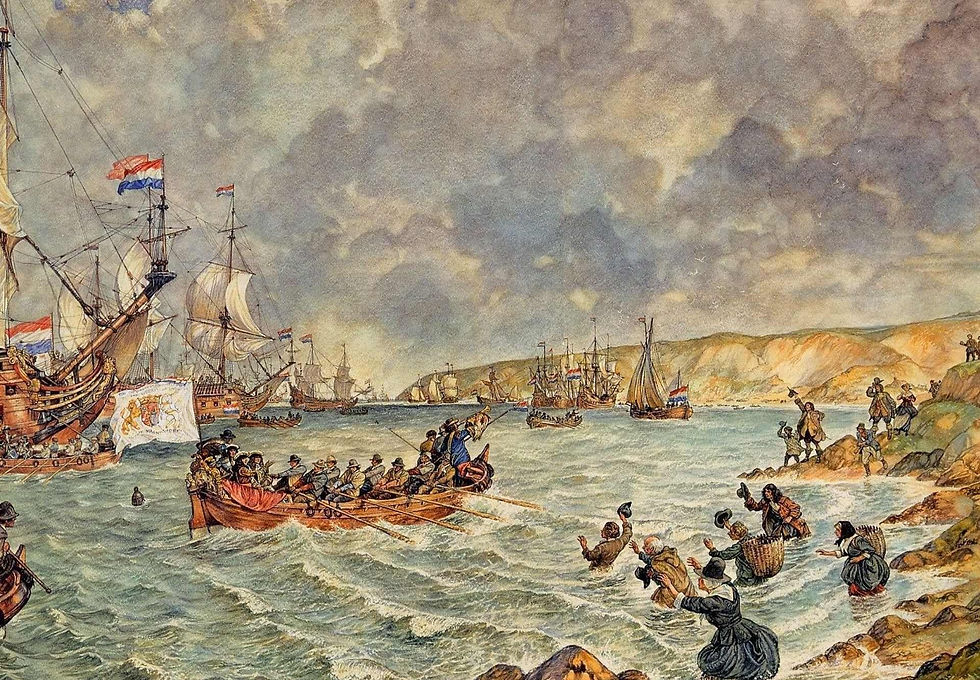
William and Mary were crowned together at Westminster Abbey in 1689. But this wasn't simply another royal succession. Parliament now had the opportunity to make clear that the monarch's powers had limits.
The result was one of the most important documents in British constitutional history: the Bill of Rights of 1689.
The Bill of Rights – The King Can't Do Whatever He Likes
The Bill of Rights restricted the monarch's ability to suspend laws, raise money and maintain a standing army without Parliament's agreement. It also strengthened parliamentary rights, including freedom of speech within Parliament.
In simple terms, the message was: the monarch is still extremely important, but the monarch cannot simply ignore Parliament.
This was a huge development in Britain's journey towards constitutional monarchy. The arguments over royal power that had helped get Charles I beheaded and James II thrown out were finally producing a clearer answer. Parliament was here to stay.
William Wasn't Particularly Popular
William was a serious Dutch military man whose great obsession was stopping the expansion of Louis XIV of France. He wasn't naturally warm or charismatic, and many English people regarded him as rather foreign.
He also spent significant periods campaigning abroad and remained deeply involved in European politics. Mary was generally more popular and governed in England while William was away.
Their marriage had begun as a political arrangement but developed into a close partnership. Sadly, they had no surviving children. Mary died of smallpox at only 32, leaving William devastated. He continued ruling alone until his own death eight years later.
Why Kensington Palace?
William suffered badly from asthma, and the smoke and damp atmosphere around the old Palace of Whitehall beside the Thames didn't help. The royal couple therefore looked for somewhere healthier, away from London's polluted centre.
They bought a country house in the small village of Kensington and employed Sir Christopher Wren to enlarge it. The result became Kensington Palace.
Today Kensington feels like central London, but in William and Mary's time it was effectively out in the countryside.

The palace became one of Britain's great royal residences and would later be associated with Queen Victoria, Princess Margaret and Diana, Princess of Wales. Not bad for a house chosen partly because the king needed cleaner air.
The King Who Defeated His Father-in-Law
James II hadn't given up his crown willingly. With French support, he travelled to Ireland hoping to regain his kingdoms. William went after him.
The two sides met at the Battle of the Boyne in 1690, where William defeated the forces supporting James. James fled back to France and never recovered his throne.
The battle remains particularly significant in Northern Irish history and is still commemorated by parts of the Protestant community today. So William didn't merely take his father-in-law's throne. He then had to fight him to keep it.
Three Things to See
Kensington Palace
This is the obvious William and Mary sight in London. They transformed an existing country house into a royal palace, and you can still explore rooms associated with their court.
When you visit, try to imagine that Kensington was once outside crowded London. William came here partly because the air was considered better for his health.
Hampton Court Palace
William and Mary also transformed Hampton Court, commissioning Sir Christopher Wren to create a spectacular new Baroque palace alongside Henry VIII's Tudor buildings.
The result is one of the things that makes Hampton Court so fascinating today: one side looks like Henry VIII's Tudor palace and another looks like the grand European palace William and Mary wanted to create.

Westminster Abbey
William and Mary were crowned together here in 1689—an extremely unusual joint coronation. They're also buried together in the Abbey, although unlike many earlier monarchs they don't have an enormous individual tomb dominating the space.
Did You Know? – William Was Only About 5'6"
William III was a successful soldier who fought major European wars and invaded England with an army, but physically he wasn't an imposing giant. He was relatively short, suffered from asthma and was often in poor health.
He was also famously reserved and serious, particularly compared with the colourful Charles II who had occupied the throne only a few years earlier.
William may not have looked like a great warrior king, but he became one of the most important monarchs in Britain's constitutional history.
Historical Highlights
1688 – William lands in England and James II flees.
1689 – William and Mary are crowned jointly.
1689 – The Bill of Rights limits royal power and strengthens Parliament.
1690 – William defeats James II at the Battle of the Boyne.
1689–90s – William and Mary develop Kensington Palace and rebuild parts of Hampton Court.
1694 – Mary dies of smallpox aged 32.
1702 – William dies and Mary's sister Anne becomes queen.
Imagine This...
It's 1689 and Westminster Abbey is preparing for something it has never seen before: two monarchs being crowned together. Mary is the daughter of the king who occupied the throne only months earlier, while William is her Dutch husband—the man who arrived in England with an army and helped drive her father into exile. Now husband and wife are receiving the crown together, but there is an important difference between them and the Stuarts who came before. Parliament has made it clear that royal power has limits. After civil war, an executed king and another king driven from the country, Britain is beginning to create a new kind of monarchy—one in which Parliament increasingly holds the real political power.
Guide's Insider Tip
When you're at Kensington Palace, take a moment to look beyond the grand royal building and imagine the area without modern London surrounding it. William and Mary chose this spot because Kensington was essentially countryside, away from the smoke and congestion of the city, and the cleaner air was thought to be better for William's asthma.

If you're also visiting Hampton Court Palace, compare the two halves of the building. Stand in Henry VIII's Tudor courtyards with their red brick, chimneys and Renaissance decoration, then walk towards William III's grand Baroque apartments. You're effectively walking between two completely different ideas of monarchy, separated by around 150 years.
And look closely at the palace exterior. Those classical statues, columns and Roman-inspired details we discussed aren't accidental—they were part of the visual language European monarchs used to make themselves look powerful, sophisticated and connected to the grandeur of the ancient world.
What Happened Next?
William and Mary had no surviving children. Mary died first, and when William died in 1702 the crown passed to Mary's younger sister Anne.
Anne's reign would finally bring together something James I had dreamed about a century earlier. England and Scotland already shared a monarch, but they were still separate countries with separate parliaments. In 1707, they officially united to create the Kingdom of Great Britain.


Comments