
Buckingham Palace – From a Duke’s Townhouse to the Home of the British Monarchy
What Is Buckingham Palace?
Buckingham Palace is probably the most famous royal palace in the world and the building most visitors immediately associate with the British monarchy.

But here's the first surprise: It wasn't built as a royal palace at all. The story begins with a large private house called Buckingham House, built for the Duke of Buckingham in the early 1700s. King George III bought it in 1761 as a private home for his wife, Queen Charlotte, and their growing family. It became known as “The Queen's House.”
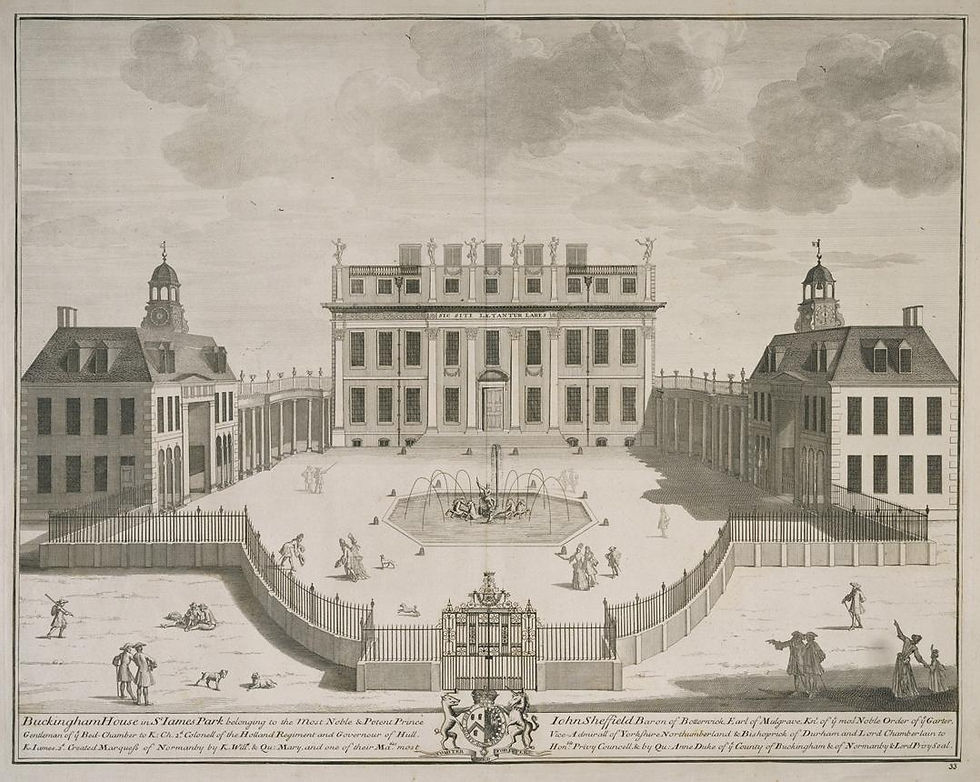
Over the following decades it was enlarged dramatically, particularly under the extravagant George IV, until the private house gradually became an enormous royal palace. But it wasn't until Queen Victoria that Buckingham Palace really became the centre of the British monarchy we recognise today.
Queen Victoria Moves In
When the 18-year-old Victoria became queen in 1837, she moved into Buckingham Palace. She was the first monarch to make it their principal London residence. For Victoria, it also meant freedom. She had grown up under the extremely restrictive “Kensington System” at Kensington Palace, rarely allowed to be alone and closely controlled by her mother and Sir John Conroy. Now she was Queen. She could finally move out. Buckingham Palace became her new home and, after she married Prince Albert, their growing family filled it with children. They had nine. The palace actually had to be expanded to accommodate the Royal Family and their enormous household.
The Famous Front Isn't the Original Front
The famous façade facing The Mall—the side with the balcony that everybody recognises—isn't what Victoria originally looked out at. An additional wing was built during Victoria's reign, enclosing what had previously been an open courtyard.
Then in 1913, during George V's reign, the exterior was refaced in the pale Portland stone we see today. So that instantly recognisable “Buckingham Palace look” is actually only just over a century old. The palace itself is much older.
And What About That Balcony?
The famous balcony is another Victorian addition. Prince Albert suggested adding a balcony to the new east front in the mid-19th century, giving the Royal Family somewhere to appear before large crowds. It turned out to be a rather good idea.
The balcony became one of the great stages of the modern monarchy: coronations, royal weddings, jubilees and major national celebrations have all produced famous appearances here.

George VI appeared here with Winston Churchill on VE Day in 1945.
Charles and Diana appeared here after their wedding in 1981.
William and Catherine kissed here after their wedding in 2011.
And Queen Elizabeth II appeared here during her final Platinum Jubilee in 2022.
One small balcony has become one of the most recognisable royal stages in the world.
Does the King Actually Live Here?
Buckingham Palace is the monarch's official London residence and administrative headquarters, but that doesn't necessarily mean the King spends every night sleeping upstairs.
King Charles III has continued to use Clarence House as his London home while Buckingham Palace has undergone a huge programme of renovation and reservicing. But Buckingham Palace remains a working royal building. This is where major receptions, investitures, diplomatic events and state occasions take place, and where the machinery of the monarchy operates behind the scenes. So it's much more than a tourist attraction. It's effectively the monarchy's headquarters.
How Big Is Buckingham Palace?
Much bigger than it looks. Buckingham Palace has 775 rooms. That includes 19 State Rooms, 52 royal and guest bedrooms, 188 staff bedrooms, 92 offices and 78 bathrooms.There are also enormous kitchens, staff areas, galleries and corridors hidden behind the famous façade.
The palace even has its own post office, medical facilities and cinema. And behind it all is something you can barely see from the street: An enormous private garden. At around 39 acres, the Buckingham Palace garden is one of the largest private gardens in central London. So when you're standing at the gates, you're really only seeing the front edge of a huge royal complex.
How Do You Know If the King Is There?
Look at the flag. When the Royal Standard is flying above Buckingham Palace, traditionally this indicates that the monarch is in residence.

The Royal Standard is divided into sections representing England, Scotland and Ireland.
And here's an important detail: The Royal Standard is never flown at half-mast.
Why?
Because there is always a sovereign. The moment one monarch dies, the heir automatically becomes the next monarch. “The King is dead. Long live the King.” If the monarch isn't in residence, you'll generally see the Union Flag flying instead.
Changing the Guard – What Is Actually Happening?
Those soldiers aren't simply performing a show for tourists. They are serving members of the British military carrying out the ceremonial handover of responsibility for guarding the royal residences.

The soldiers in red tunics and bearskin hats belong to regiments of the Household Division. During Changing the Guard, the “Old Guard” hands responsibility over to the “New Guard”, accompanied by military bands. The ceremony is wonderfully theatrical. But underneath all the music, marching and bearskins, something very straightforward is happening: One military guard is finishing its shift and another is taking over.
Why Are Their Hats So Enormous?
The famous black hats are called bearskins. They became associated with British Foot Guards after the defeat of Napoleon at the Battle of Waterloo in 1815. French Imperial Guard soldiers wore bearskin-style headgear, and the British Guards later adopted bearskins as part of their ceremonial uniform. The idea was partly to make soldiers appear taller and more intimidating.
So there's another London connection:
Wellington → Waterloo → Wellington Arch → guards in bearskins outside Buckingham Palace. Once you start connecting London's stories, they're everywhere.
The Palace Was Bombed During World War II
Buckingham Palace was bombed several times during World War II. George VI and Queen Elizabeth remained based in London during the working week rather than permanently retreating to safety, and they were at the palace during some of the bombing. After one attack, Queen Elizabeth famously said she was glad they had been bombed because she felt she could now “look the East End in the face.” The East End had suffered terribly during the Blitz.

The Royal Family obviously lived with far greater protection and privilege than ordinary Londoners, but their decision to remain visibly present in the capital became an important part of the monarchy's wartime image. Then, five years later, Buckingham Palace became the scene of celebration. On VE Day in 1945, enormous crowds filled The Mall while George VI, Queen Elizabeth, Princess Elizabeth, Princess Margaret and Winston Churchill appeared on the balcony.

What Happens Inside the Palace?
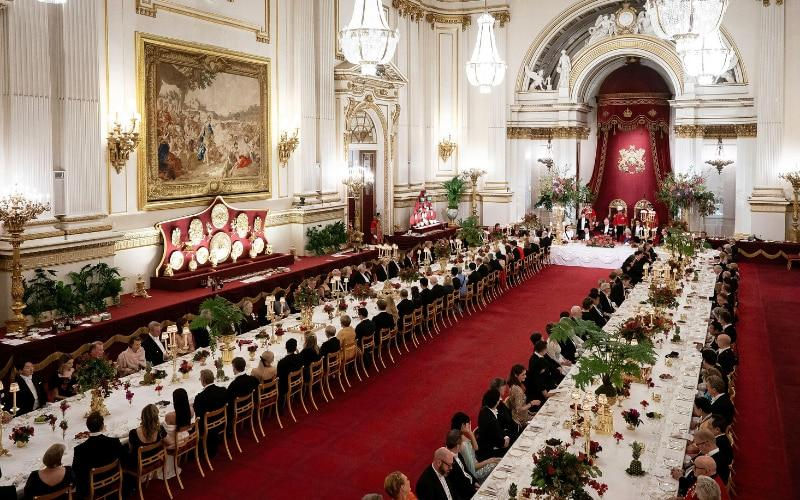
Some of Britain's grandest ceremonial events take place inside the State Rooms. Visiting presidents and monarchs can be entertained at enormous state banquets.
People receiving honours attend investitures, where decorations such as knighthoods are presented.
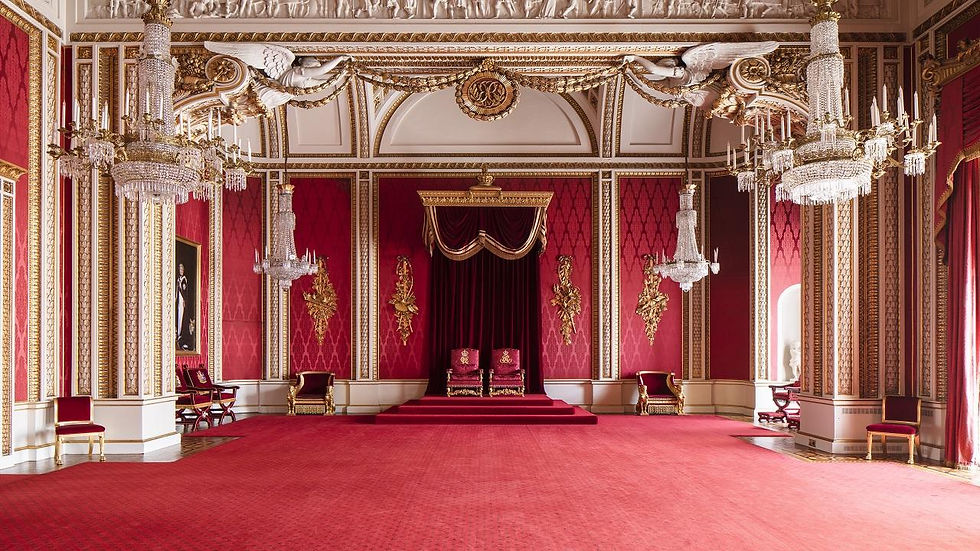
The monarch also hosts receptions for people from across British public life.
One of the grandest rooms is the Ballroom, created during Queen Victoria's reign and still used for state banquets and major ceremonial occasions.
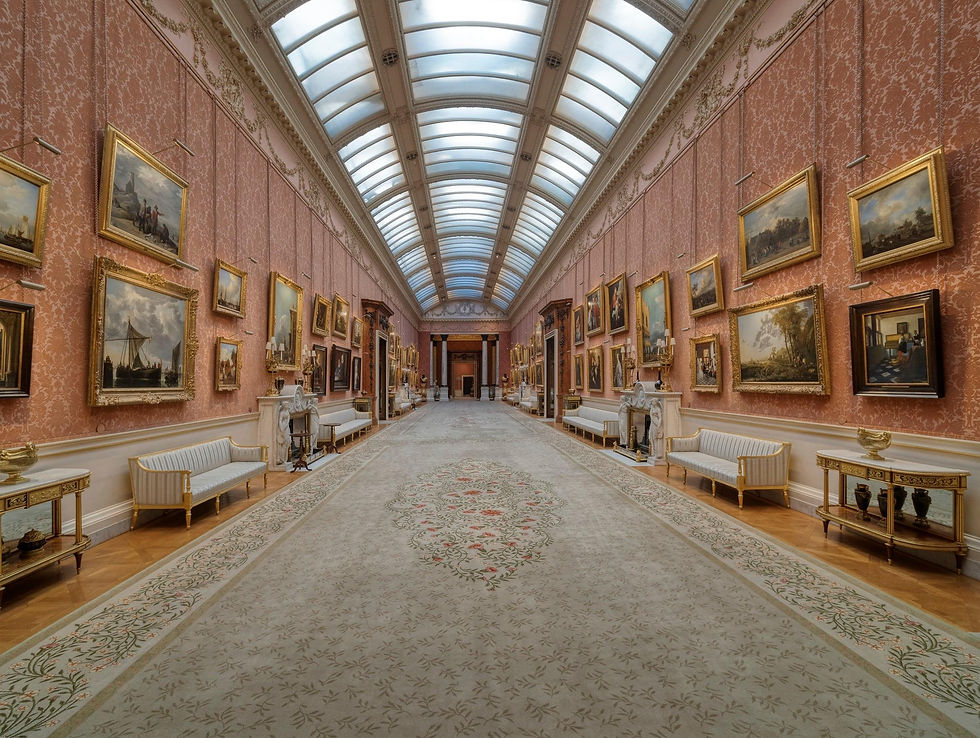
Then there is the magnificent Picture Gallery, containing works from the Royal Collection. So behind the guards and tourists outside the gates, Buckingham Palace is still very much a working building.
Can You Go Inside?
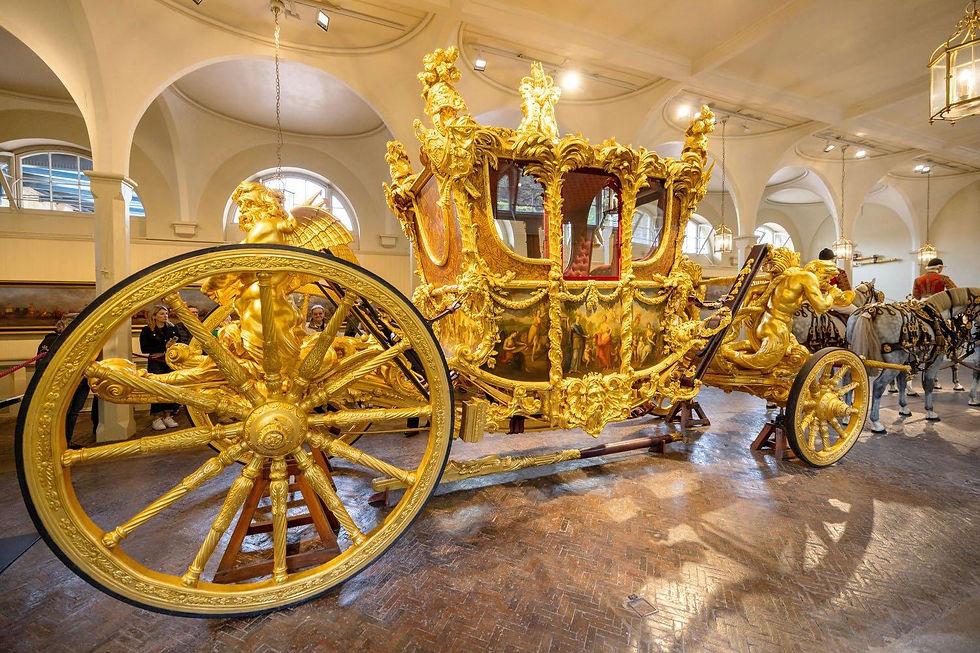
Yes—but not whenever you fancy. The State Rooms are normally opened to visitors during selected periods of the year, traditionally including the summer, when the monarch is away from London. Visitors can see some of the magnificent ceremonial rooms used for official entertaining. The King's Gallery, beside the palace, operates separately and hosts changing exhibitions from the Royal Collection. You can also visit the Royal Mews, where royal coaches and carriages are kept. And this is where you'll find one of the most spectacular vehicles in Britain: The Gold State Coach. It's enormous, covered in gold leaf and has been used at coronations since George IV. It also has a reputation for being spectacularly uncomfortable. Apparently even kings can't have everything.
Three Things to See
The Palace Balcony & Victoria Memorial
Stand in front of the Victoria Memorial and look directly towards the palace. This is the classic view. The memorial commemorates Queen Victoria—the first monarch to make Buckingham Palace their principal London residence—while behind it stands the palace that became the international symbol of her descendants. Then look up at the balcony. Think VE Day, royal weddings, jubilees and coronations. You are looking at one of the world's most famous stages.
Changing the Guard
If the ceremony is taking place during your visit, it's absolutely worth seeing once. But remember: you're not watching actors. These are real soldiers carrying out ceremonial military duties. Don't necessarily stand directly against the palace gates either. Depending on the day's arrangements, you can sometimes get a better sense of the procession from The Mall or around St James's Palace.
The Royal Mews
If you're interested in royal ceremony, don't overlook the Royal Mews. This is where the monarchy's ceremonial vehicles are kept, including the extraordinary Gold State Coach.
Seeing it close up makes televised coronation processions suddenly make much more sense. It is less like a carriage and more like a small golden building on wheels.
Did You Know? – There’s an ATM Inside Buckingham Palace
With 775 rooms and hundreds of people working behind the scenes, Buckingham Palace functions almost like a tiny village. And yes, there is reportedly a cash machine inside the palace, provided for members of the Royal Household. Unfortunately, visitors can't just wander in and withdraw £20. The palace has also had its own post office and other facilities required to keep an enormous working royal household functioning. It's a useful reminder that behind the gilded State Rooms and balcony appearances are hundreds of ordinary people keeping the place running.
The Victoria Memorial – Britain Showing Off
Standing directly in front of Buckingham Palace is the enormous Victoria Memorial, created after Queen Victoria's death to commemorate her extraordinary 63-year reign.

But don't think of it as simply a statue of Victoria—the whole monument is packed with symbolism about how Victorian Britain saw itself. Victoria sits at the centre looking down The Mall, with figures representing qualities such as Justice, Truth and Motherhood around her. Motherhood was particularly appropriate: Victoria had nine children, whose marriages into European royal families helped earn her the nickname “Grandmother of Europe.”
Then look right to the very top. The huge golden figure is Victory, standing on a globe and holding a palm branch—an ancient symbol of triumph. Around the memorial you'll also spot lions, ships, sea creatures and figures representing ideas such as peace, progress, industry and agriculture.
There's a strong message of Empire and naval power running through the whole thing. By the time Victoria died in 1901, Britain controlled an enormous global empire and was one of the world's dominant powers. The monument reflects that confidence—although today we also understand the conquest, exploitation and violence that accompanied British imperial expansion. So when you're standing here, don't just see a statue of an elderly queen. Think of the Victoria Memorial as Victorian Britain advertising itself: Queen and Empire in the centre, Justice and Truth beside her, and golden Victory standing on top of the world. The Victorians weren't exactly known for understatement.
Historical Highlights
1700s – Buckingham House is built.
1761 – George III buys it for Queen Charlotte.
1820s – George IV begins transforming the house into a palace.
1837 – Queen Victoria moves in as the first monarch to make it their principal London residence.
1840s – Victoria and Albert expand the palace as their family grows.
1913 – The famous east façade is refaced into the appearance we recognise today.
1940 – Buckingham Palace is bombed during the Blitz.
1945 – Huge crowds gather outside for VE Day.
1953 – Elizabeth II appears here during her coronation celebrations.
2022 – Elizabeth II makes her final balcony appearance during the Platinum Jubilee.
2023 – Charles III and Queen Camilla appear on the balcony following their coronation.
Imagine This...
It's 8 May 1945 and The Mall is completely packed. After almost six years of war, Nazi Germany has surrendered and London has exploded into celebration. Thousands upon thousands of people are pushing towards Buckingham Palace, chanting for the King. George VI and Queen Elizabeth step onto the balcony with their daughters Elizabeth and Margaret, and later Winston Churchill joins them. The palace behind them still carries the memory of German bombs, but now the crowd below is celebrating victory. The Royal Family appears again and again because the people simply won't leave. A building that began as a duke's private country house has become the stage on which Britain celebrates its biggest national moments.
Guide's Insider Tip
When you're standing at the Victoria Memorial, don't just photograph Buckingham Palace and leave. Turn around. Look straight down The Mall towards Admiralty Arch. The enormous ceremonial avenue was deliberately designed to create a grand approach to the palace, and during coronations, jubilees and state visits it becomes one of Britain's great ceremonial stages.
Then look back at the palace and check the flag. If you see the Royal Standard, the King is in residence; if you see the Union Flag, he generally isn't. If Changing the Guard is happening, don't assume the palace gates are automatically the best place to stand. The ceremony involves movements between St James's Palace, Wellington Barracks and Buckingham Palace, so there are several places from which you can watch different parts of it.
And finally, walk through St James's Park afterwards. Within a few minutes you can connect Buckingham Palace with St James's Palace, Clarence House, Horse Guards, Whitehall and Westminster. That's when you realise Buckingham Palace isn't standing on its own. It's sitting at the centre of an entire royal and ceremonial landscape.
What Happened Next?
Buckingham Palace began as a private house. George III turned it into a royal family home. George IV turned it into a palace. Victoria turned it into the monarch's principal London residence. George V gave its famous façade the appearance we recognise today. George VI stood on its balcony after Britain survived World War II. Elizabeth II made that balcony famous around the world. And Charles III appeared there after his coronation in 2023. The people inside have changed. The role of the monarchy has changed. Britain itself has changed enormously. But Buckingham Palace has become something far bigger than simply the King's London residence. It has become the public face of the British monarchy.


Comments