
Queen Victoria (1837–1901) – The Queen Who Gave Her Name to an Empire and an Era
Who Was Queen Victoria?
Victoria was just 18 years old when she became queen in 1837. Her uncle William IV had died without a legitimate surviving child, so messengers arrived at Kensington Palace early in the morning to tell the teenage princess that she was now Queen of the United Kingdom.
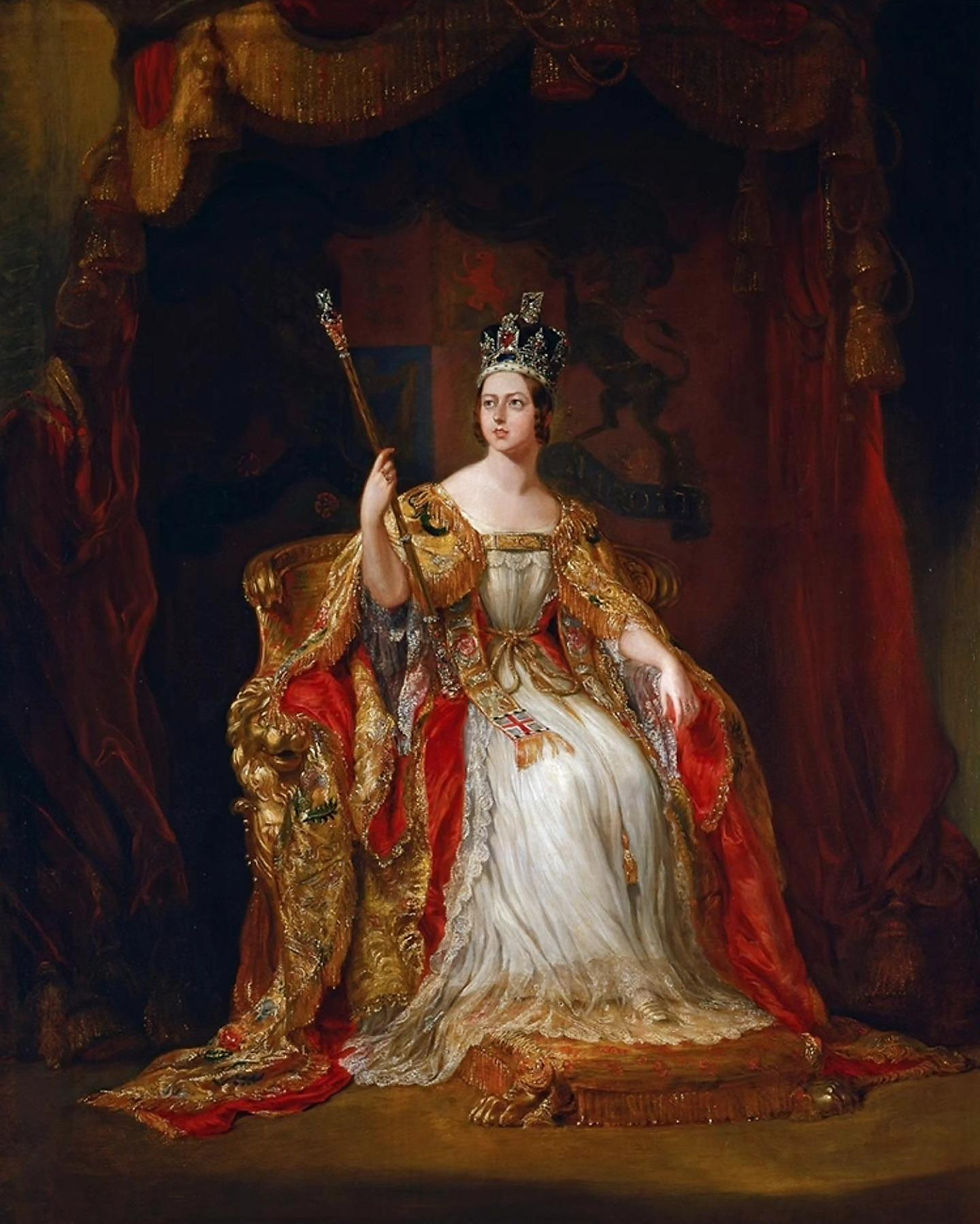
She had grown up at Kensington under the extremely controlling “Kensington System,” devised by her mother and adviser Sir John Conroy. Victoria was rarely allowed to be alone and even had to share a bedroom with her mother. Becoming queen finally gave her something she desperately wanted: independence.
One of her first decisions was to move into Buckingham Palace, making her the first monarch to use it as the principal London royal residence. She would remain queen for more than 63 years and give her name to an entire age: the Victorian era.
Victoria and Albert – A Royal Love Story
Victoria married her German first cousin Prince Albert of Saxe-Coburg and Gotha in 1840. This wasn't simply a cold royal marriage. Victoria fell passionately in love with him and actually had to propose to Albert because, as queen, protocol meant he couldn't formally propose to her. Together they had nine children.

Those children married into royal families across Europe, giving Victoria the nickname “Grandmother of Europe.”Among her descendants were monarchs and royal families in Britain, Germany, Russia, Spain, Greece and several other European countries. Albert also became Victoria's closest adviser and took a keen interest in science, education, industry and the arts. Their partnership would help define Victoria's reign.
The Great Exhibition – Victorian Britain Shows Off
In 1851, Albert helped organise the spectacular Great Exhibition in Hyde Park. Britain was experiencing the Industrial Revolution: factories, steam engines, railways, engineering and mass manufacturing were transforming the country. The Great Exhibition was effectively an enormous international showcase where Britain and other nations displayed their latest inventions, manufactured goods, art and technology.
At its centre was the extraordinary Crystal Palace, a gigantic building made from iron and glass. Millions of people visited. The profits helped fund institutions in South Kensington including the Victoria and Albert Museum, Science Museum and Natural History Museum. That's one reason the area around Exhibition Road became nicknamed “Albertopolis.”

The Queen of an Enormous Empire
During Victoria's reign, the British Empire expanded dramatically across Asia, Africa and other parts of the world. Britain already had colonies before Victoria became queen, but during the nineteenth century the Empire grew enormously. In 1876 Victoria was given another impressive title: Empress of India. At its greatest extent—actually after Victoria's death—the British Empire would control roughly a quarter of the world's land and population.
Empire was closely connected with trade and Britain's growing industrial power. British businesses wanted raw materials such as cotton, tea, sugar and rubber, as well as overseas markets in which to sell British manufactured goods. Britain's powerful Royal Navy protected shipping routes and strategic locations around the globe, while the Industrial Revolution made Britain a world leader in manufacturing, engineering and finance. Together, industrialisation, trade and Empire helped make Victorian Britain one of the wealthiest and most powerful countries in the world.
But the Empire wasn't simply a glorious British success story. Millions of people were governed by Britain without choosing British rule, and imperial expansion often involved conquest, violence, loss of land and economic exploitation. British rule also introduced railways, ports, schools, legal systems and other infrastructure in many places, although these were often created partly to serve Britain's own economic and military interests. The legacy is therefore complicated, but it's still all around us today—from the worldwide use of the English language and Westminster-style parliaments to the Commonwealth and the wonderfully multicultural population of modern London.
Then Albert Died
Everything changed for Victoria in 1861.

Albert became seriously ill and died at Windsor Castle aged just 42. Victoria was devastated.
She dressed in black mourning clothes for the rest of her life and largely withdrew from public appearances for years. Her prolonged absence eventually caused criticism, with some people questioning why the country was paying for a monarchy whose queen was rarely seen.
This is the Victoria we often picture today: an elderly, serious-looking woman dressed entirely in black.

But that image can be misleading. Young Victoria had loved dancing, parties, music and theatre and had been passionately in love with her husband. Albert's death changed her.
Why Are There So Many Things Named Victoria and Albert?
Once you start looking around London, they are everywhere.
Victoria Station. Victoria Street. Victoria Embankment. Victoria Park. The Victoria and Albert Museum. Then there is Albert Bridge, Albert Hall and the enormous Albert Memorial opposite it.

Some names were created during Victoria's lifetime; others commemorate either Victoria or Albert. Together they turned huge parts of London into a permanent memorial to their age. The most spectacular is probably the Albert Memorial in Kensington Gardens, commissioned by Victoria after Albert's death. Albert sits beneath an enormous Gothic canopy looking towards the Royal Albert Hall. It's basically grief expressed through architecture on a monumental Victorian scale.
The Victorian London We Recognise Today
Victoria didn't personally build Victorian London, of course, but her extraordinarily long reign coincided with London's transformation into the largest and one of the wealthiest cities in the world.
Railways arrived, great railway stations appeared, suburbs spread outward and London's population exploded. After the horrific Great Stink of 1858, engineer Joseph Bazalgette created a huge new sewer system beneath London. His work also helped create the Victoria Embankment beside the Thames.
Many of the museums, railway stations, bridges, hotels, theatres, department stores and rows of terraced houses visitors associate with London today are products of the Victorian age. Walk around London and you are constantly walking through Victoria's world.
Three Things to See
Kensington Palace
Victoria was born at Kensington Palace in 1819 and grew up here. You can visit rooms connected with her childhood and learn about the moment she was told she had become queen at just 18. It's the perfect place to begin her story: the controlled young princess who woke up one morning and suddenly discovered she was the most powerful woman in Britain.
Buckingham Palace
Victoria became the first monarch to make Buckingham Palace her principal London residence when she moved in shortly after becoming queen in 1837. After marrying Albert, it became their family home and eventually had to be expanded to accommodate their growing family. The famous balcony that dominates royal occasions today was added as part of those Victorian alterations.
Albert Memorial & Royal Albert Hall
Walk through Kensington Gardens and you'll find one of London's grandest expressions of royal grief: the Albert Memorial. Victoria commissioned it after Albert's death, and directly opposite stands the Royal Albert Hall. Look closely at the memorial and you'll see sculptures representing different continents, arts, sciences and industries—a perfect snapshot of how Victorian Britain saw itself and its place in the world.
Did You Know? – Victoria Was Only 4'11"
Queen Victoria projected an enormous image of royal authority, but physically she was tiny—only around 4 feet 11 inches tall.
She also wasn't actually called Victoria by her family when she was young. Her full name was Alexandrina Victoria, and as a child she was known as Drina. When she became queen, she chose to reign simply as Victoria. The tiny teenage “Drina” from Kensington Palace would eventually become one of the most recognisable monarchs in world history.

Historical Highlights
1819 – Victoria is born at Kensington Palace.
1837 – Becomes queen aged 18.
1840 – Marries Prince Albert.
1851 – Great Exhibition opens in Hyde Park.
1861 – Prince Albert dies aged 42.
1876 – Victoria becomes Empress of India.
1887 – Golden Jubilee celebrates 50 years on the throne.
1897 – Diamond Jubilee celebrates 60 years.
1901 – Victoria dies after a reign of more than 63 years.
Imagine This...
It's 1897 and London is packed with enormous crowds celebrating Victoria's Diamond Jubilee. The tiny 18-year-old princess who inherited the throne 60 years earlier is now a 78-year-old grandmother and Empress of India, surrounded by representatives and troops from an empire stretching across the globe. London itself has transformed around her: railways thunder into enormous stations, electric lighting is beginning to appear, underground trains run beneath the streets and millions of people live in a city that has become the heart of a global empire. Victoria has buried her beloved Albert, watched her nine children marry into Europe's royal families and seen Britain transformed by industry, science and technology. Few monarchs have ever become so closely associated with an entire period of history that the age itself takes their name.
Guide's Insider Tip
When you're in Kensington, you can tell almost Victoria's entire life story within one walk. Start at Kensington Palace, where she was born and where the teenage Victoria learned she had become queen. Then cross Kensington Gardens to the enormous Albert Memorial, built after the death of the husband she adored, and look directly across the road towards the Royal Albert Hall.
Continue into South Kensington and you'll reach the Victoria and Albert Museum, part of the extraordinary cultural legacy that grew out of Albert's Great Exhibition. And whenever you see Victoria depicted as the stern little old lady dressed in black, remember that isn't the whole woman. The young Victoria loved parties, dancing and staying up late. The black clothes came later. They weren't really her personality. They were her grief.
What Happened Next?
When Victoria died in 1901 aged 81, she had been queen for more than 63 years. Almost nobody alive could remember another monarch.
But there was one slight problem with calling the next royal family the Hanoverians.
Victoria belonged to the House of Hanover, but her children took their father's dynastic house: Saxe-Coburg and Gotha. Her eldest son finally became king aged 59. He had spent decades waiting for the job and was very different from his serious mother. He loved society, food, racing, shooting, travelling and fashionable London. The Victorian age was over. The Edwardian age had begun.


Comments