
George III (1760–1820) – The King Who Lost America
Who Was George III?
George III became king aged just 22 when his grandfather George II died. His father, Frederick, Prince of Wales, had died nine years earlier, so the crown skipped a generation.

Unlike George I and George II, George III was born in Britain and spoke English as his first language. Soon after becoming king, he proudly declared that he was “born and educated in this country” and gloried in the name of Briton. Unfortunately, ask most Americans what they remember about George III and you probably won't hear about his British credentials. He's the king who lost America.
Why Did America Rebel?
Britain had spent enormous amounts of money fighting France in the Seven Years' War, including protecting its colonies in North America. Afterwards, the British government believed the American colonies should contribute more towards the cost of their defence.
Parliament introduced taxes including the Stamp Act and duties on goods such as tea. Many colonists objected because they had no representatives in the British Parliament—the famous complaint of “no taxation without representation.” Tensions escalated through events such as the Boston Massacre and Boston Tea Party, and fighting began in 1775. The following year, the thirteen colonies issued the Declaration of Independence.
One important point: George III didn't personally dream up all these taxes. Britain was already a constitutional monarchy and the policies were passed by governments and Parliament. George did, however, strongly oppose American independence and supported continuing the war.

George Washington Versus King George
For Americans, George III became the face of British oppression. The Declaration of Independence lists a long series of complaints against the king, repeatedly beginning with the words “He has…” But Britain was fighting more than rebellious colonists. France entered the war on the American side, followed by Spain and the Dutch Republic, turning the conflict into a much larger international war.
In 1781, British forces under Lord Cornwallis surrendered at Yorktown, and Britain eventually recognised American independence in 1783. George III hadn't simply lost a few troublesome colonies. Britain had lost the United States of America.
Did George III Really Go Mad?
George III is remembered almost as much for his mental illness as for losing America. He suffered several severe periods of illness, particularly from 1788 onwards, during which he could become extremely agitated and speak for hours without stopping.
For many years it was popularly claimed that George suffered from porphyria, a rare physical illness that could produce psychiatric symptoms. Modern historians and medical researchers have questioned that diagnosis, and bipolar disorder has been suggested instead. We simply cannot diagnose him with certainty more than two centuries later.
What we do know is that his treatment could be horrifying. At Kew, doctors subjected him to methods including powerful medicines, cold baths, bleeding and physical restraint. After a particularly severe decline, George became permanently incapable of ruling. In 1811 his eldest son took over as Prince Regent, beginning the period we call the Regency.
Farmer George
There's another George III that's easily forgotten. George was fascinated by agriculture, science, astronomy, books and plants. His interest in farming earned him the nickname “Farmer George.” It was originally intended to mock him but actually suited a king who took a genuine interest in improving agriculture.
He was also the first British king to receive a systematic education in science and supported the astronomers William and Caroline Herschel, whose work led to the discovery of Uranus. George built an enormous library too. So the cartoon image of the stupid king who lost America is unfair. He was curious, educated and serious about his responsibilities—although he could also be extremely stubborn.
George and Queen Charlotte
George married the German princess Charlotte of Mecklenburg-Strelitz in 1761. Their first meeting was basically their wedding introduction: Charlotte arrived in England, met George the following day and married him that evening. Fortunately, the arranged marriage became a close and affectionate partnership. George was unusually faithful by the standards of eighteenth-century kings, and the couple had an astonishing 15 children.
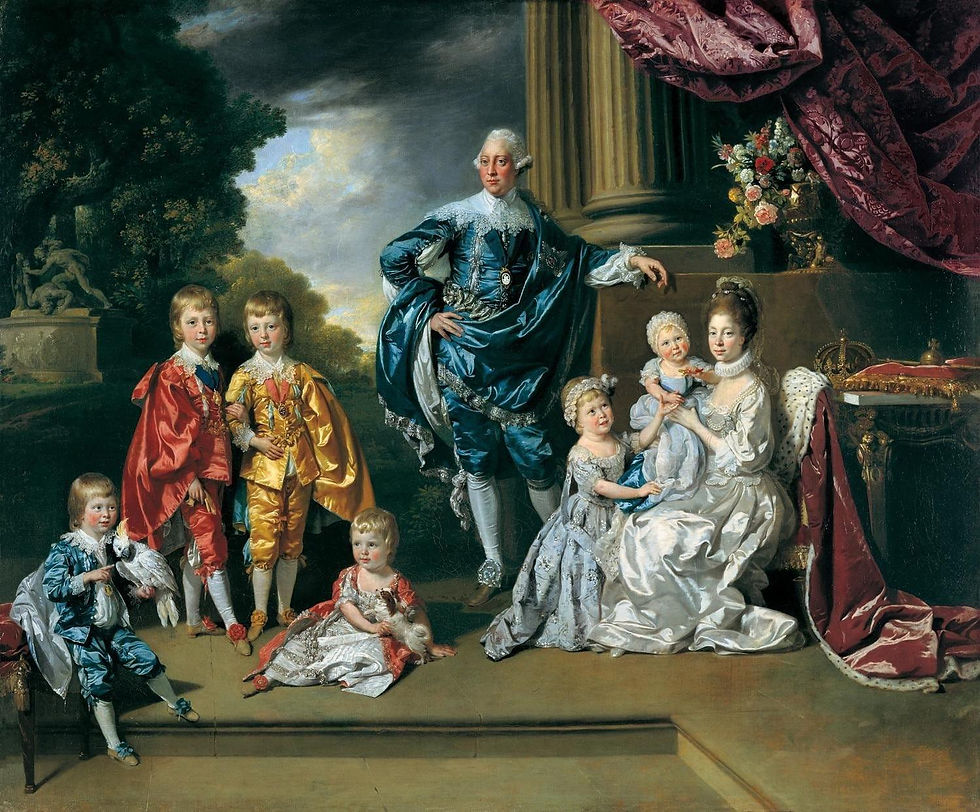
George bought Buckingham House for Charlotte as a comfortable family home near St James's Palace. It became known as the Queen's House and would eventually develop into Buckingham Palace. And yes—Charlotte, North Carolina, is named after Queen Charlotte. So American visitors get two wonderful geographical connections from this royal family: New York from James, Duke of York, and Charlotte from George III's queen.
Britain Fights Napoleon
Losing America certainly didn't mean Britain stopped fighting.
Revolution broke out in France in 1789, the French monarchy was overthrown and eventually Napoleon Bonaparte emerged as France's dominant figure. Britain became one of Napoleon's greatest enemies, beginning another enormous period of warfare.
Britain's great naval victory came at Trafalgar in 1805, where Admiral Nelson defeated the French and Spanish fleets. Ten years later, the Duke of Wellington helped finally defeat Napoleon at Waterloo.
By then George was too ill to play an active role in government, but these victories transformed Britain's position in the world. Ironically, the king who lost America also reigned while Britain emerged from the Napoleonic Wars as one of the world's dominant powers.

Three Things to See
Kew Palace
If you want to understand George III as a person rather than simply “the king who lost America,” Kew Palace is probably the best place in London to visit. This tiny red-brick palace was a private royal retreat where George, Charlotte and their children could escape some of the formality of court life. Sadly, it later became the place where George was confined and treated during periods of severe illness. You can still explore rooms associated with George and Charlotte, while the nearby Royal Kitchens have survived remarkably intact.
Buckingham Palace
George III bought Buckingham House in 1761 for Queen Charlotte, and it became their family home. Their children were born and raised there, which is why it became known as the Queen's House. The building looked very different from today's Buckingham Palace. Later monarchs dramatically enlarged and remodelled it, but George III is an important part of the reason the Royal Family ended up here in the first place.
Westminster Abbey
George and Charlotte were crowned together at Westminster Abbey in 1761, just two weeks after their wedding. But unlike many earlier monarchs, George isn't buried there. He and Charlotte are buried at St George's Chapel, Windsor Castle. By this period, Windsor was becoming increasingly important as the royal family's burial place.
Did You Know? – George III Never Visited America
For a man so closely associated with the American Revolution, George III never actually set foot in America. He never stood in Boston, Philadelphia, New York or Virginia. The king whom American revolutionaries portrayed as their great oppressor was sitting thousands of miles away in Britain, governing through ministers and Parliament.
Even more strangely, George Washington never visited Britain either. The two Georges whose names dominate opposite sides of the American Revolution never met.
Historical Highlights
1738 – George is born in London.
1760 – Becomes king aged 22.
1761 – Marries Queen Charlotte and buys Buckingham House.
1775 – American Revolutionary War begins.
1776 – American Declaration of Independence.
1783 – Britain recognises American independence.
1788 – George suffers a severe episode of illness.
1801 – Great Britain and Ireland unite to create the United Kingdom.
1805 – Nelson defeats Napoleon's fleet at Trafalgar.
1811 – George's son becomes Prince Regent.
1815 – Napoleon is defeated at Waterloo.
1820 – George III dies after almost 60 years on the throne.
Imagine This...
It's 1776 and across the Atlantic thirteen British colonies have just declared that they are no longer British at all. In Philadelphia, revolutionaries accuse George III of tyranny and announce the creation of a new country, while back in London the king is determined that the rebellion must be defeated. George has never visited America and will never meet George Washington, yet his name will forever be linked with the birth of the United States. The war drags on, France joins America's side and eventually Britain is forced to accept defeat. For George, losing America is a humiliation—but his reign is far from over. He will remain king for almost another forty years while Britain fights Napoleon, experiences the beginnings of the Industrial Revolution and emerges as one of the most powerful nations in the world.
Guide's Insider Tip
When you're visiting Kew Gardens, don't overlook little Kew Palace. Compared with Buckingham Palace or Windsor Castle it looks almost like an ordinary country house, and that's precisely what makes it interesting. This is where you get a much more personal glimpse of George III, Queen Charlotte and their huge family.
Then head towards the Great Pagoda, built while George was a young man. George was fascinated by architecture, botany and science, and Kew is a wonderful reminder that there was much more to him than America and his illness. And next time you're standing outside Buckingham Palace, remember that the story of the world's most famous royal palace partly begins with George III buying a house for his wife. Buckingham Palace was essentially a Georgian family home before it became the great ceremonial palace we know today.
What Happened Next?
By the final years of George III's reign, the king was blind, increasingly deaf and severely ill. His eldest son had already taken over his royal duties as Prince Regent in 1811.
When George III died in 1820, that son finally became George IV. And if George III had presented himself as a dutiful family man interested in farming and science, George IV was almost his complete opposite. He loved fashion, parties, enormous meals, extravagant buildings and spending staggering amounts of money. The Regency was about to get very glamorous—and very expensive.


Comments