
Elizabeth II (1952–2022) – The Queen Who Became a Global Icon Through 70 Years of Change
Who Was Elizabeth II?
Elizabeth II was never originally expected to become queen. When she was born in 1926, her uncle Edward was heir to the throne and everyone assumed he would eventually marry and have children of his own.

Then came Edward VIII's abdication. Her father unexpectedly became George VI, and ten-year-old Elizabeth suddenly found herself next in line.
In February 1952, the 25-year-old Princess Elizabeth was in Kenya with her husband Prince Philip when her father died. She had left Britain a princess and returned home Queen Elizabeth II. She would remain queen for an extraordinary 70 years, becoming the longest-reigning monarch in British history and one of the most recognisable people in the world.
A Coronation Watched by Millions
Elizabeth's coronation took place at Westminster Abbey on 2 June 1953.
The ceremony itself was ancient, but the way people watched it was completely modern: television.

Despite initial reservations about cameras inside the Abbey, the coronation was televised and watched by millions. For many families, it was the event that persuaded them to buy their first television set.
This was a turning point for the monarchy. Previous monarchs had been distant figures seen in newspapers, paintings and occasional public appearances. Now the Queen could appear inside people's living rooms. The modern media monarchy had arrived.

From Empire to Commonwealth
Elizabeth inherited a very different world from Queen Victoria. The enormous British Empire was already disappearing. India and Pakistan had become independent during George VI's reign, and throughout Elizabeth's reign many more territories across Africa, the Caribbean and Asia became independent nations.
Instead of trying to remain their ruler, Elizabeth became a passionate supporter of the Commonwealth—a voluntary association of independent countries, many of which had historical connections with the British Empire. This was a huge transformation. Victoria had been Empress of India. Elizabeth II became Head of the Commonwealth. The relationship had changed from an empire controlled largely from Britain into an association of independent states.

The Queen Who Never Gave an Interview
Elizabeth became one of the most famous people on Earth, yet remarkably she never gave a conventional sit-down media interview. Her public role was carefully controlled. She opened Parliament, met prime ministers, hosted foreign leaders, travelled around the world and carried out thousands of engagements, but rarely expressed personal political opinions. That wasn't accidental.
Britain is a constitutional monarchy, meaning the monarch reigns but elected politicians govern. Elizabeth understood that remaining politically neutral was essential to the survival of the modern monarchy. During her reign she worked with 15 British prime ministers, beginning with Winston Churchill and ending with Liz Truss.
Imagine the history contained between those two names.
Prince Philip – 73 Years Together
Elizabeth married Prince Philip of Greece and Denmark in 1947, five years before she became queen.
Philip gave up his foreign royal titles, became a British subject and eventually became Duke of Edinburgh. When Elizabeth became queen, he had the unusual role of being married to the monarch without being king himself.
Why wasn't he King Philip? Traditionally, the husband of a reigning queen does not automatically become king, because “king” historically implied a higher-ranking sovereign position. Philip therefore remained Prince Philip.
Their marriage lasted 73 years. Philip died in 2021 aged 99. Because Britain was still under COVID restrictions, the Queen sat alone in St George's Chapel at his funeral, an image that became one of the most memorable of her final years.
The Monarchy Has a Difficult Decade
The Royal Family wasn't always universally popular during Elizabeth's reign.
The most difficult period came during the 1990s. Three of the Queen's four children experienced marital breakdowns, Windsor Castle suffered a devastating fire and arguments erupted over who should pay for repairs. The Queen described 1992 as her “annus horribilis”—Latin for “horrible year.”
Then came Princess Diana. After Diana died in a car crash in Paris in 1997, enormous crowds gathered outside Kensington Palace and Buckingham Palace. The Queen initially remained at Balmoral with Princes William and Harry, leading to criticism that the monarchy seemed distant from the extraordinary public grief. She eventually returned to London and gave a televised address paying tribute to Diana. The episode taught the monarchy an important lesson: tradition wasn't enough—the public increasingly expected emotion and visibility too.
The Queen Becomes a Global Icon
Elizabeth adapted remarkably well for someone born before television was commonplace. She moved from radio to television, then eventually to the internet and social media. And she occasionally showed a wonderfully unexpected sense of humour.
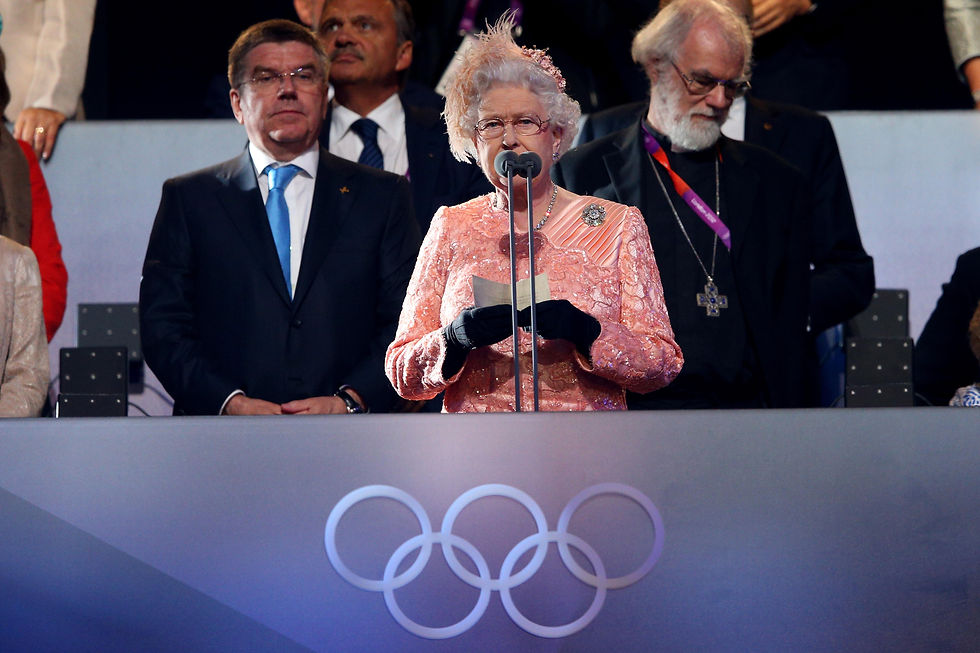
For the London 2012 Olympics, she appeared in a famous filmed sequence with James Bond, played by Daniel Craig, before a stunt double appeared to parachute into the Olympic Stadium.
For her Platinum Jubilee in 2022, she filmed tea with Paddington Bear, finally revealing what she supposedly kept in her famous handbag: A marmalade sandwich.

These moments worked because Elizabeth normally behaved with such restraint. When she joined the joke, everyone noticed.
Seventy Years on the Throne
Elizabeth celebrated a Silver Jubilee in 1977, Golden Jubilee in 2002, Diamond Jubilee in 2012 and Platinum Jubilee in 2022.
By then she had become something far bigger than simply Britain's head of state. For most British people, she had always been there. She had become queen when Churchill was Prime Minister, Stalin ruled the Soviet Union and Harry Truman was President of the United States. She lived through the Cold War, the Moon landing, the Beatles, the internet, Brexit and COVID. Presidents and prime ministers came and went. The Queen remained.
The Final Days
In September 2022, Elizabeth was at Balmoral Castle in Scotland. Despite declining health, she formally appointed Liz Truss as Prime Minister on 6 September. A photograph from that meeting shows the 96-year-old Queen smiling and carrying out one of her most important constitutional duties. Two days later, on 8 September 2022, Elizabeth II died at Balmoral.

Her eldest son Charles immediately became king. Elizabeth's coffin travelled from Scotland to London, where she lay in state at Westminster Hall. Hundreds of thousands of people queued for hours to pay their respects. Her state funeral was held at Westminster Abbey before she was taken to Windsor. She was buried in St George's Chapel beside Prince Philip, close to her parents George VI and Queen Elizabeth the Queen Mother.

Three Things to See
Buckingham Palace
No building is more closely associated with Elizabeth II. The palace was her official London residence and the setting for everything from royal balcony appearances and state visits to jubilees and national celebrations.
Look at the balcony and think of 70 years of royal history—from the young Queen appearing after her coronation to the elderly monarch greeting crowds during her Platinum Jubilee.
Westminster Abbey
Elizabeth was both married and crowned here. She married Philip at Westminster Abbey in 1947, was crowned here in 1953 and, 69 years later, her state funeral was held in the same building. Few places tell her story more completely.
Windsor Castle & St George's Chapel
Windsor was particularly important to Elizabeth and became increasingly central to her life in her later years. Inside St George's Chapel is the King George VI Memorial Chapel, where Elizabeth is buried beside Prince Philip. Her parents George VI and Queen Elizabeth the Queen Mother are there too, along with the ashes of Princess Margaret. It's one of the most personal places connected with the late Queen.
Did You Know? – The Queen Didn't Need a Passport
Elizabeth II travelled more widely than any previous British monarch, visiting well over 100 countries. But she didn't need a British passport. British passports were issued in the Queen's name, so it would have been rather strange for her to issue one to herself.
The same principle applied to driving licences, and Elizabeth famously loved driving—something she had learned during World War II when, as a princess, she trained as a driver and mechanic with the Auxiliary Territorial Service. King Charles III now enjoys the same passport privilege.
Historical Highlights
1926 – Elizabeth is born in London.
1936 – Her father unexpectedly becomes George VI after Edward VIII abdicates.
1947 – Marries Prince Philip.
1952 – Becomes queen aged 25.
1953 – Coronation at Westminster Abbey.
1977 – Silver Jubilee.
1992 – The Queen's “annus horribilis.”
1997 – Princess Diana dies.
2002 – Golden Jubilee.
2012 – Diamond Jubilee and London Olympics.
2021 – Prince Philip dies.
2022 – Platinum Jubilee celebrates 70 years on the throne.
8 September 2022 – Elizabeth II dies aged 96.
Imagine This...
It's June 1953 and a 27-year-old Elizabeth sits inside Westminster Abbey wearing St Edward's Crown while millions watch her coronation on television. Britain is still recovering from World War II, food rationing hasn't completely ended and much of the British Empire still exists. Now fast-forward 69 years. Elizabeth has watched the Empire largely become the Commonwealth, worked with 15 prime ministers, travelled around the world, seen Britain transformed by immigration and social change and moved from radio broadcasts to appearing with Paddington Bear on the internet. The young woman who inherited the Crown in a very different Britain has become a familiar grandmotherly figure recognised around the globe. Elizabeth didn't rule Britain for 70 years—elected governments did—but she became the constant figure standing quietly in the background while almost everything around her changed.
Guide's Insider Tip
When you're standing outside Buckingham Palace, don't just think of it as the Queen's house. Think of it as a stage on which Britain watched Elizabeth's entire reign unfold: coronation celebrations, royal weddings, jubilees, state visits and eventually the crowds gathering after her death.
Then walk through St James's Park towards Westminster Abbey. Elizabeth married Philip here, was crowned here and had her funeral here. Three enormous moments in one life happened in the same building.
And if you're visiting Windsor Castle, go into St George's Chapel. Elizabeth's final resting place is surprisingly simple compared with the enormous tombs of earlier monarchs. After 70 years as one of the world's most recognisable women, she lies beside the husband with whom she shared 73 years of marriage.
What Happened Next?
At the moment Elizabeth II died on 8 September 2022, her eldest son automatically became king. At 73 years old, Charles had waited longer than any previous British heir to inherit the throne. He had spent his life as Prince of Wales campaigning on issues including architecture, heritage and the environment, while his marriage to Diana and relationship with Camilla had made him one of the most scrutinised members of the Royal Family. Now, after seven decades of Elizabeth II, Britain had something most people had never experienced: a king.


Comments